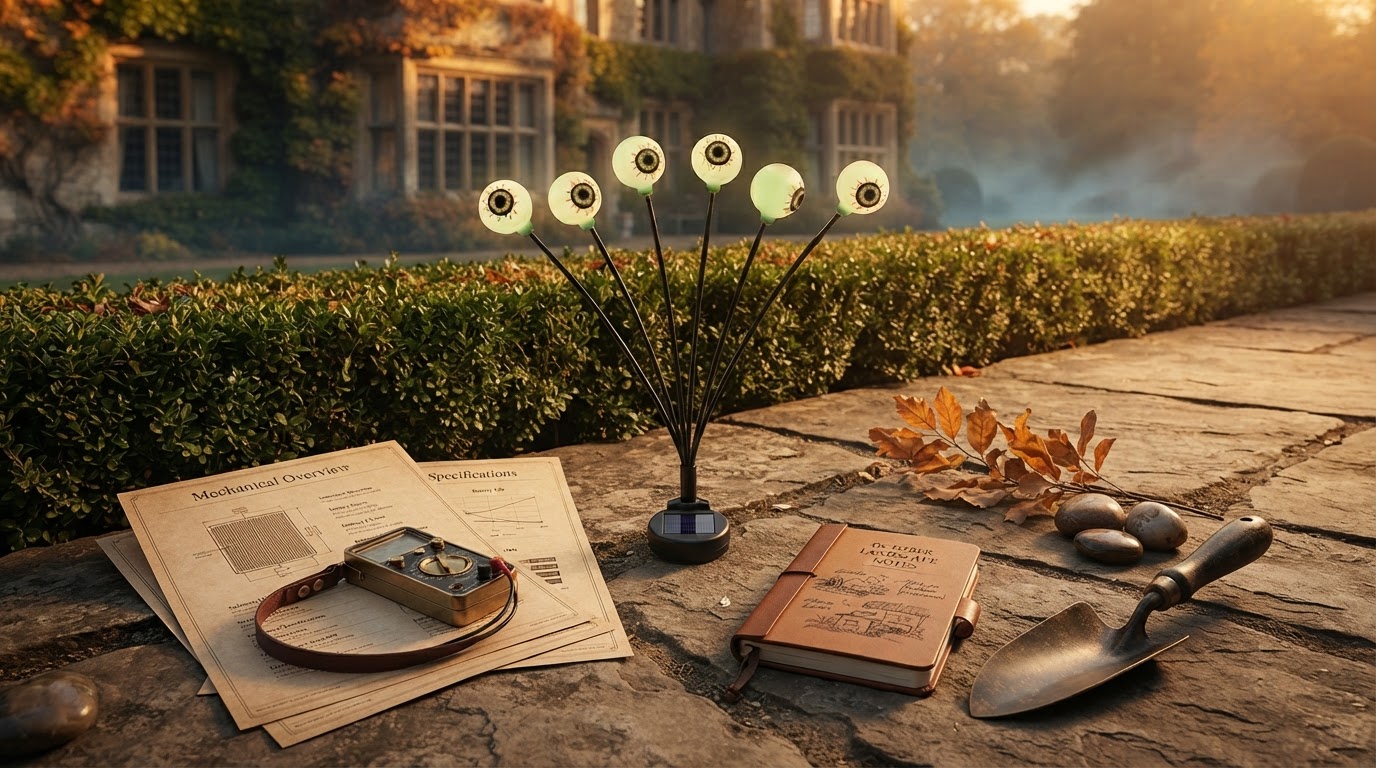
Solar Powered Halloween Eyeball Lights for Landscape Design
 Maya ChenContributing Editor
September 1, 2026. This technical overview examines the mechanical and electrical specifications of solar-powered swaying eyeball lights for outdoor installations. It is written for property managers and homeowners seeking durable, energy-independent decorative solutions for October displays.
The Mechanical Inefficiency of Static Outdoor Decor
The conventional wisdom says that static lawn decorations provide the best return on investment for seasonal curb appeal because they lack moving parts that inevitably fail in autumn weather. However, static displays often disappear into the visual noise of a suburban neighborhood. The industry is shifting toward kinetic energy in lighting, yet most consumers overlook the physics of how these displays actually function. According to Alibaba.com, the integration of a 3D design and swaying eyeball mechanism is specifically engineered to add a terrifying mood to dark corners by mimicking organic movement. Run the math: a static prop requires high-intensity localized lighting to remain visible at night, whereas a swaying 6-LED array leverages the human eye's natural sensitivity to motion. Most "spooky" lighting fails because it relies on high-wattage plug-in systems that limit placement to the proximity of an exterior outlet. This constraint forces clusters of decorations near the foundation, leaving the perimeter of the property dark and uninviting. By utilizing independent solar cells, these units can be distributed across the entire landscape, including spooky solar eyeball garden stakes that define property boundaries without the hazard of extension cords crossing wet grass.
Engineering the Swaying Halloween Eyeball Lights System
Halloween Eyeball Lights solve the logistical bottleneck of traditional wiring through a high-conversion solar panel integrated directly into the stake. While many cheap alternatives use low-grade plastic stems, these units utilize a flexible support structure designed to catch ambient wind. Here’s the part nobody talks about: the "sway" isn't powered by a motor; it is a passive kinetic response to air currents, which preserves the battery life for the LED illumination. Research into firefly solar eyeball lights shows that this passive movement creates a more unpredictable, and therefore more unsettling, visual effect than a programmed mechanical rotation. The internal components typically feature a 1.2V Ni-MH battery and a 2V/120mA solar panel. In optimal conditions, this allows for eight to ten hours of operation after a six-hour charge cycle. The light source itself generally consists of bloodshot green or purple LEDs encased in a waterproof 3D eyeball shell. Unlike standard string lights that suffer from total circuit failure if one bulb is compromised, these independent stakes operate on a decentralized power model. This makes firefly eyeball lights solar powered systems significantly more resilient against heavy rain or frost compared to traditional series-wired sets. Poshmark listings for these Halloween Decorations Outdoor Eyeball Lights confirm that the realistic 3D design is critical for maintaining the illusion during daylight hours, preventing the yard from looking like a graveyard of plastic trash when the sun is up.
Technical Criteria for Solar Eyeball Deployment
Selecting a solar-powered lighting array requires more than just an aesthetic preference; it requires an assessment of the installation site's solar exposure and soil density. The effectiveness of the swaying motion is directly tied to the height of the stake and the flexibility of the neck. When planning a layout that includes outdoor halloween eyeball decorations, consider the wind patterns of your specific microclimate. If the stakes are placed too close to a windbreak, such as a solid fence or thick hedge, the kinetic swaying effect is neutralized. Conversely, placing them in high-wind corridors requires deeper stake penetration to prevent the units from leaning or dislodging. I’ll change my mind about the superiority of solar when grid-tied systems can offer the same level of placement flexibility without the fire hazard of daisy-chained power strips. Until then, the decentralized solar model remains the only logical choice for large-scale residential displays.
- Verify the IP65 waterproof rating to ensure the internal circuitry survives October rainfall.
- Calculate the total LED count across the lawn to ensure a minimum of 40-60 lumens per 10 square feet for visibility.
- Check the flexibility of the support rods; rigid rods fail to produce the "firefly" swaying effect.
- Ensure the solar panels are adjustable to a 45-degree angle to maximize UV absorption during shorter autumn days.
- Standardize on a single color temperature (e.g., green or purple) to maintain visual cohesion across the landscape.